“Can machines think?”: Turing’s 1950 question
Alan Turing opened a 1950 paper with that question, then replaced it with a test, and answered Ada Lovelace by name.
The machine that can be any machine
In 1936, aged 24, Alan Turing published a paper on a problem in mathematical logic. To solve it, he imagined a very simple device that reads and writes symbols on a tape, following a table of rules. He showed that one such machine, a universal machine, could imitate any other, given the right instructions on its tape.
That idea, a single machine that does any computation given the right program, is the theoretical heart of every computer. It also raised an obvious question: if reasoning can be written as rules, can a machine reason?
“Can machines think?”
During the war Turing worked as a codebreaker at Bletchley Park. In October 1950 he published “Computing Machinery and Intelligence” in the philosophy journal Mind. It opens: “I propose to consider the question, ‘Can machines think?’”
Since “think” is hard to define, he replaced the question with a game. A judge exchanges typed messages with a hidden person and a hidden machine. If the judge can’t reliably tell which is which, Turing argued, there is no good reason to deny that the machine thinks. This is the imitation game, now called the Turing test.
Answering Ada Lovelace
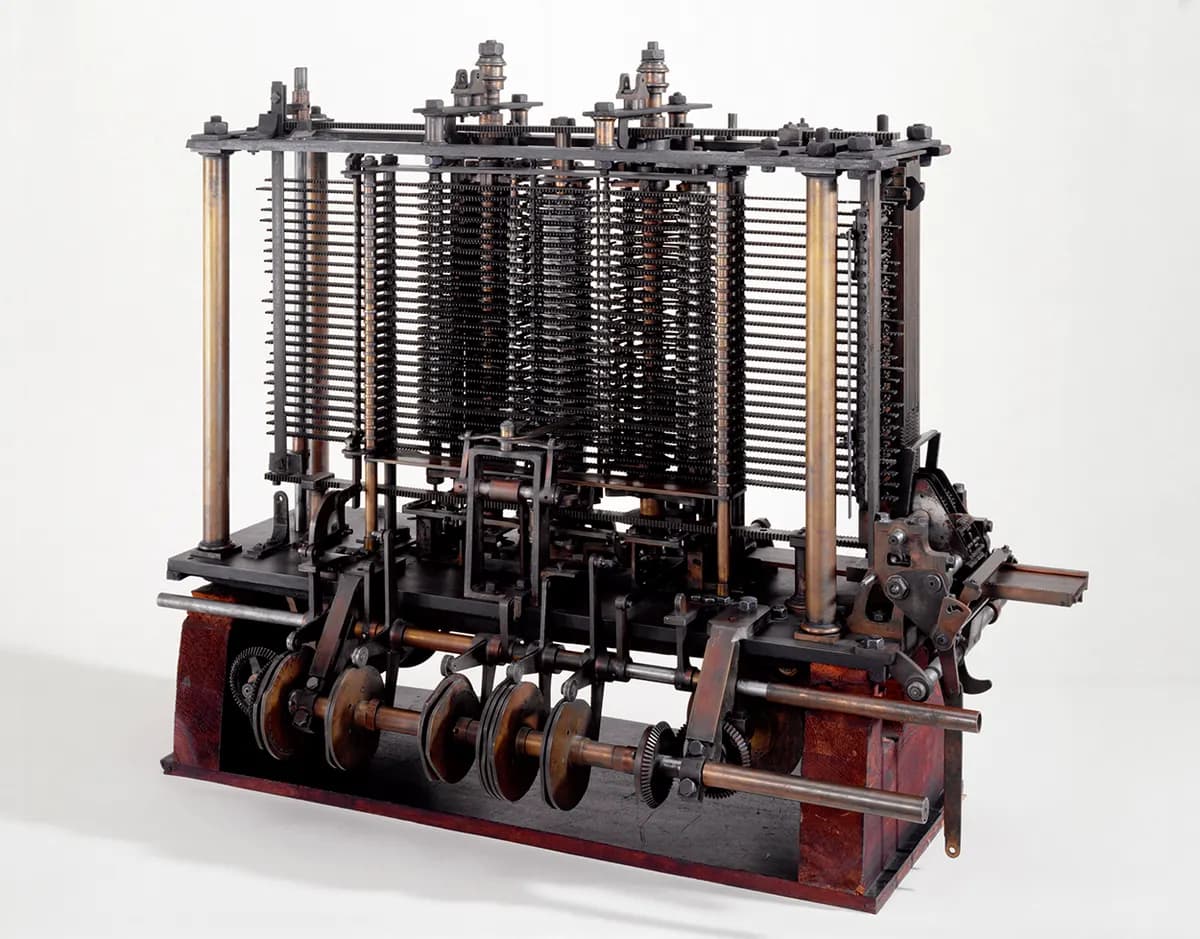
Turing went through objections one by one. One he called Lady Lovelace’s Objection: in 1843 Ada Lovelace had written that the Analytical Engine “has no pretensions whatever to originate anything”; it can only do what we order it to. Turing replied that machines surprise us all the time, because we can’t foresee all the consequences of their instructions.
“I propose to consider the question, ‘Can machines think?’”
Bring it up
“Turing’s famous 1950 paper on thinking machines replies directly to Ada Lovelace, who had died almost a century earlier.”
Follow the thread
- RelatedThe 1960s chatbot people confided in ELIZA showed how easily a conversation can seem intelligent, which complicates Turing’s test.
- In contrastThe first computer programmer was a poet’s daughter Turing argued against “Lady Lovelace’s Objection” that machines can only do what we tell them.
- InfluencedThe dream of thinking machines is thousands of years old Turing turned Leibniz’s dream of mechanical reasoning into mathematics.
- Leads toAI got its name from a summer workshop proposal Six years later, a summer workshop gave the field its name.