The 1960s chatbot people confided in
ELIZA just reflected your words back as questions. Its creator’s secretary still asked him to leave the room so she could talk to it in private.
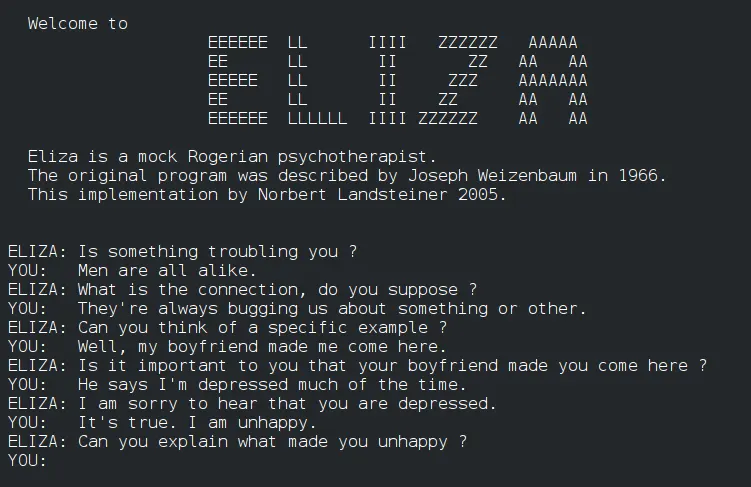
Joseph Weizenbaum, a computer scientist at MIT, wrote ELIZA between 1964 and 1967. Its best-known script, DOCTOR, played a Rogerian psychotherapist, a style of therapy in which the therapist mostly reflects the patient’s words back.
That made it easy to fake:
User: I’m unhappy at work. ELIZA: Why do you say you are unhappy at work? User: My boss doesn’t listen to me. ELIZA: Tell me more about your boss.
ELIZA had no understanding at all. It matched keywords and rearranged sentences using templates.
The secretary
People responded as if it understood them anyway. Weizenbaum’s own secretary, who knew how it worked, asked him to leave the room so she could talk to it privately. Some psychiatrists suggested automated therapy might soon be practical.
Its creator’s alarm
Weizenbaum was disturbed. He wrote that “extremely short exposures to a relatively simple computer program could induce powerful delusional thinking in quite normal people.” In Computer Power and Human Reason (1976) he argued that human thought can’t be reduced to computation, and that some decisions, involving judgement, care and ethics, should never be handed to machines, whether or not they could make them.
The ELIZA effect
Today, the ELIZA effect means our tendency to attribute understanding and feelings to programs that produce human-like text. The modern chatbots are vastly more capable than ELIZA, which makes Weizenbaum’s questions more relevant, not less.
“I had not realized … that extremely short exposures to a relatively simple computer program could induce powerful delusional thinking in quite normal people.”
Bring it up
“In the 1960s, people opened up to a chatbot that only rephrased their sentences. Its own creator was alarmed.”
Follow the thread
- RelatedFrom a bedroom GPU to ChatGPT Today’s chatbots revive Weizenbaum’s worries at a far larger scale.
- Same patternThe chess-playing machine that had a man inside In both cases people attributed a mind to a machine, though with the Turk there really was a person inside.
- Same patternThe same face, three different emotions The audience supplies the emotion; the machine, or the film, just provides the prompt.
- Related“Can machines think?”: Turing’s 1950 question ELIZA showed how easily a conversation can seem intelligent, which complicates Turing’s test.
- Same patternDoes listening to Mozart make you smarter? Both are cases where a modest finding or illusion grew into a much bigger popular belief.