A slime mould designed the Tokyo rail network
Scientists put oat flakes where Tokyo’s cities are. A brainless single-celled organism grew a network remarkably like the real railway.
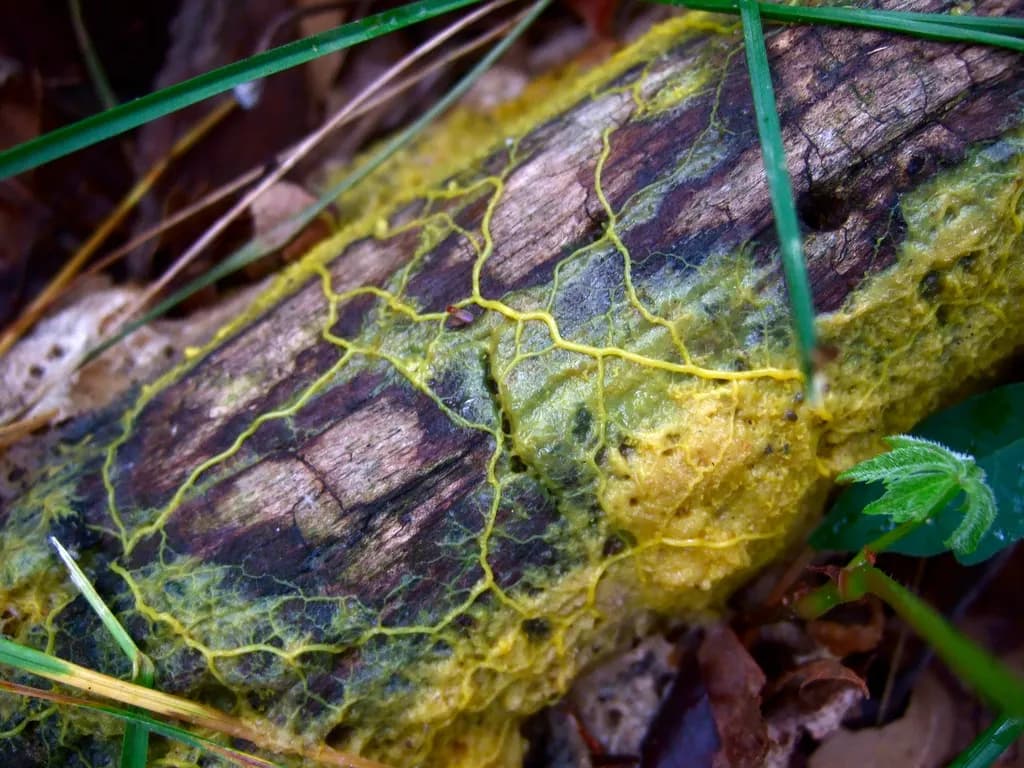
Physarum polycephalum is a bright yellow slime mould: a single cell that can grow to the size of a dinner plate. It has no brain and no neurons. It still solves problems.
The experiment
Researchers led by Atsushi Tero and Toshiyuki Nakagaki placed oat flakes on a dish at the positions of 36 cities around Tokyo, put the slime mould where Tokyo is, and let it grow. Bright light, which the mould avoids, stood in for mountains and the sea.
At first it spread everywhere. Then it pruned weak tubes and thickened the useful ones. After about a day it had produced a network of tubes linking the food sources. In efficiency, cost and resilience to broken links it was comparable to the real Tokyo-area rail network.
How a cell can do this
The rule is simple: tubes carrying more flow grow thicker, and tubes carrying less flow shrink. Applied everywhere at once, this local feedback produces good global solutions. The team turned it into a mathematical model that engineers can use to design adaptive networks.
Earlier, Nakagaki had shown the mould could find the shortest path through a maze. The research won Ig Nobel Prizes in 2008 and 2010, awarded for work that first makes people laugh and then makes them think.
Watch
Not the Tokyo study: the same slime mould, Physarum polycephalum, in a 2015 experiment (sped up). It branches out from an oat flake in every direction, then a thick tube forms towards the plant roots in the dish on the left.
Bring it up
“A single-celled slime mould with no brain produced a transport network about as good as Tokyo’s railway.”