The spandrel: a by-product that looks like a purpose
Not every feature of a living thing was ‘designed’ for a job. Two biologists borrowed a word from cathedral builders to make the point, and then architects argued about whether they had the cathedral right.
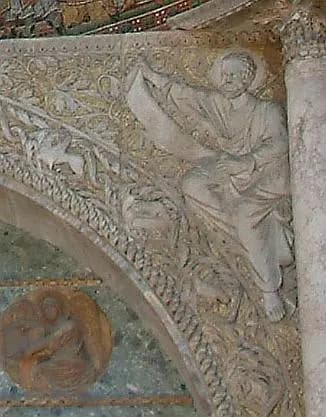
Picture a dome resting on a ring of round arches. Where the arches meet, curved triangles of masonry are left over. Medieval and Renaissance builders often decorated them with mosaics of saints or evangelists. The architectural word for such a leftover space is a spandrel.
Borrowing a word
In 1979 the biologists Stephen Jay Gould and Richard Lewontin used the image of the basilica of San Marco in Venice to make a point about evolution. A visitor who saw only the ornate mosaics might think the triangles existed in order to hold the pictures. In fact the spaces are a by-product of the architecture, and the decoration came afterwards.
Their warning was about what they called the adaptationist programme: the habit of explaining every trait as a finely tuned solution to some problem. Some features, they argued, come along for the ride, and inventing a neat story for each one is storytelling, not evidence. They borrowed the name of Voltaire’s Dr Pangloss, who insisted this was the best of all possible worlds.
The architects object
Here the story gets a twist worth enjoying. Critics pointed out that the San Marco features are really pendentives, a specific kind of curved support, not simple spandrels. The philosopher Daniel Dennett went further, arguing that builders chose pendentives among other options and that they do real structural work, so they are not purely accidental.
Gould replied that the word could reasonably be stretched to mean any space left over. Most commentators agree the architectural slip does not damage the biological argument. It is a good reminder that analogies need checking too.
Why bring it up
The idea travels well. Is a habit, a rule or a tradition there because of a clever purpose, or is it a leftover of something else? The next time someone offers a neat explanation, you can ask, kindly, whether it might be a spandrel.
Bring it up
“Biologists borrowed the word ‘spandrel’ from architecture to mean a feature that exists only because of something else, though the building they used as their example turns out to be a bit of a cheat.”
Follow the thread
- In contrastChesterton’s fence: ask why it’s there before you tear it down Chesterton warns against removing something before knowing its purpose; the spandrel warns against assuming a purpose that was never there.
- RelatedVenice stands on an upside-down forest The same city whose hidden foundations are admired also supplied the basilica used for this argument.
- Same patternThe golden ratio is less magic than you’ve heard Both show how easily we read deliberate design into patterns that may have simpler explanations.