The arch that hangs upside down
Hang a chain from two points, photograph it, flip the picture, and you have the ideal shape for an arch.
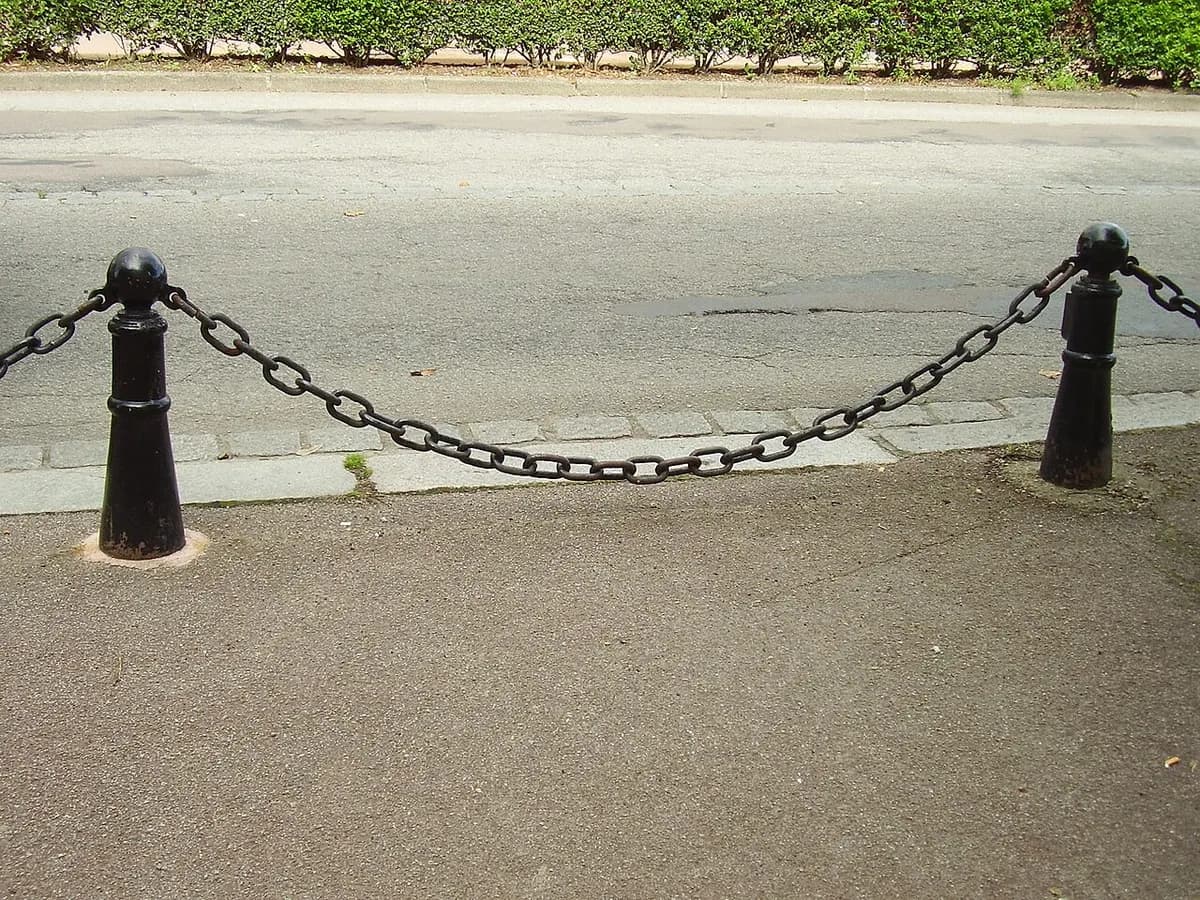
Take a chain and hold it by both ends. It sags into a smooth curve. Now imagine freezing that curve and flipping it upside down. You have just designed an arch.
Why it works
Every link in a hanging chain is pulled along the chain, never pushed or bent. That is what a chain can do. The curve it settles into is called a catenary, from the Latin for chain.
Turn it over and every pull becomes a push. Stone and brick are strong when squeezed and weak when stretched or bent, so an arch of this shape keeps all its material in compression. That is why such arches can stand without glue or iron.
Hooke’s riddle
In 1675 the English scientist Robert Hooke published a Latin anagram in an appendix to a book on telescopes. Anagrams were a common way to claim an idea without giving it away. In 1705, after his death, his executor revealed the solution: ut pendet continuum flexile, sic stabit contiguum rigidum inversum. Roughly: as hangs the flexible line, so, inverted, will stand the rigid arch.
A common mix-up
For a long time the hanging curve was assumed to be a parabola. It is not: they look alike near the bottom but differ further out. The true equation was worked out in the 1690s.
Designing with string
The idea is also a design method. Hang weighted cords from a board, and the forces draw the structure for you; photograph or mirror the result and you have a vault. Antoni Gaudí is famous for using hanging models in this spirit, and the attic of Casa Milà in Barcelona is covered by a series of catenary arches. Whether he knew Hooke’s riddle in particular is unclear, and it does not matter: the physics is the same.
Something to try
Next time you see a chain or a washing line, remember that it is drawing you an arch. Look for the shape in bridges and vaults: the Gateway Arch in St Louis is a famous, slightly flattened relative.
Bring it up
“A hanging chain and a good stone arch have the same shape, one just upside down, and Robert Hooke announced that in a riddle.”
Follow the thread
- In contrastBrutalism isn’t named after being brutal Brutalist concrete often shapes buildings by sculptural will; a catenary arch lets the forces choose the shape.
- Same patternThe golden ratio is less magic than you’ve heard Another case where a tidy-looking curve gets mistaken for something else (here, the parabola).
- RelatedJulius Caesar’s secret code (and why it failed) Hooke hid his discovery in an anagram, a small piece of cryptography used to claim priority.