Leonardo’s math teacher wrote the first guide to accounting
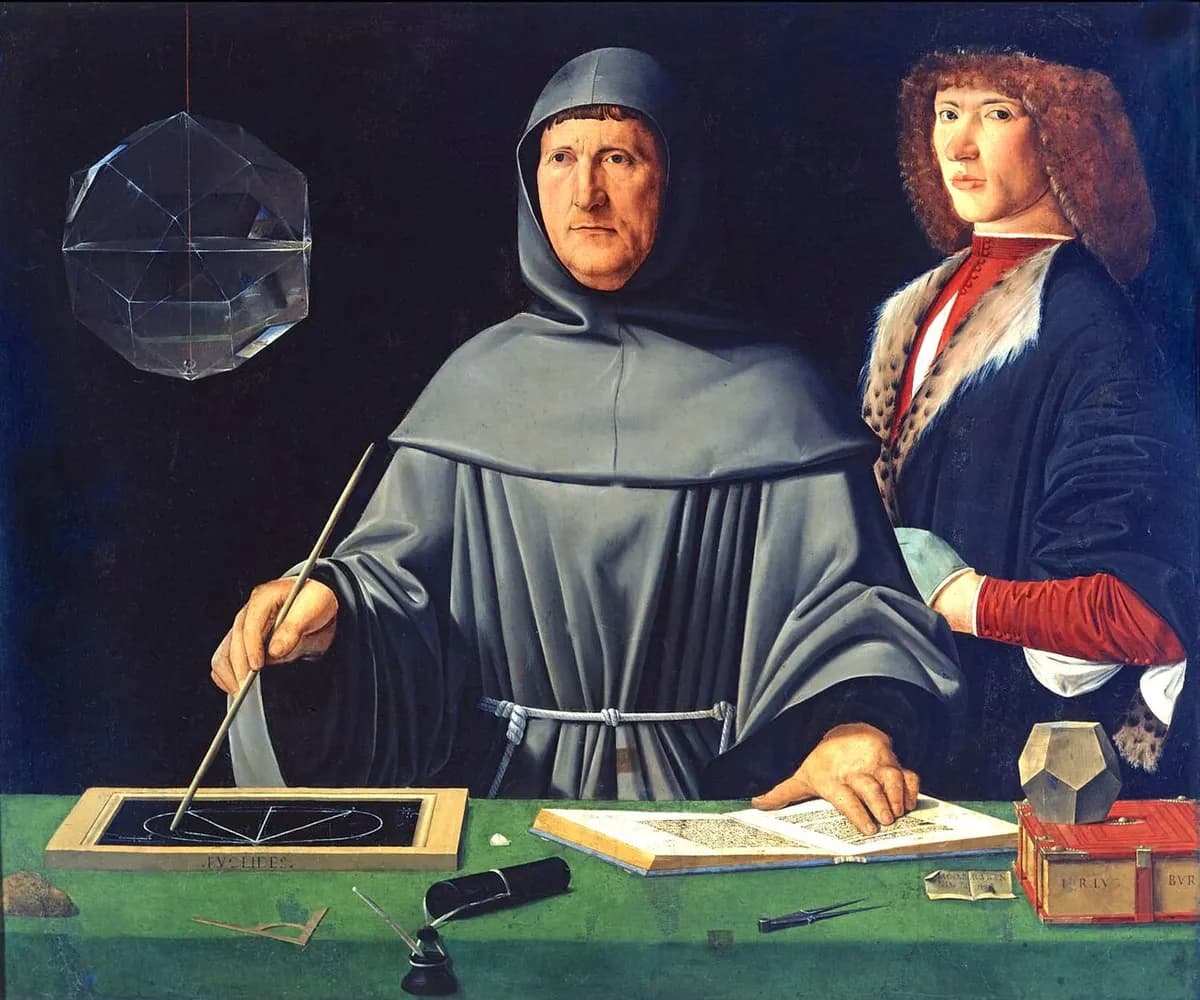
The friar who taught Leonardo da Vinci mathematics also published the first printed guide to double-entry bookkeeping, the system nearly every company still uses.
The idea behind double entry is simple: every transaction is recorded twice, as a debit in one account and a credit in another. Selling goods for cash increases cash and decreases inventory. Because the two sides must always balance, errors and fraud become much easier to spot.
Italian merchants were using it by the 13th and 14th centuries. Surviving Florentine and Genoese ledgers show it. In 1494, the Franciscan friar Luca Pacioli described the “method of Venice” in his Summa de arithmetica, one of the first printed mathematics books. The printing press carried it across Europe.
The Leonardo connection
Pacioli lived in Milan with Leonardo da Vinci and taught him mathematics. Leonardo, in return, drew the remarkable polyhedra for Pacioli’s De divina proportione (1509), a book about the golden ratio. So the friar is linked both to the Renaissance image of perfect proportion and to the balance sheet.
Why it matters
Double entry made it possible to see a business as a single entity separate from its owner, with assets, debts and profit that can be measured. Some historians link that abstraction to the growth of joint-stock companies and capitalism itself. That link is an interpretation, but the influence of double-entry bookkeeping on how organisations think about money is hard to overstate.
Bring it up
“The person who taught Leonardo da Vinci geometry is also the father of modern accounting.”