Computers began as looms
The first machine controlled by punched cards was not a calculator. It wove silk.
Weaving a complicated pattern used to take two people: a weaver and a “draw boy” who lifted the right threads at the right moment. Joseph Marie Jacquard replaced the draw boy with cards.
Each card had a row of holes. Where there was a hole, a hooked rod passed through and lifted a thread. Where there was no hole, the rod was blocked. String thousands of cards together and the loom will weave any image without human judgement. That is binary instructions stored on an external medium, in other words software.
The portrait that impressed Babbage
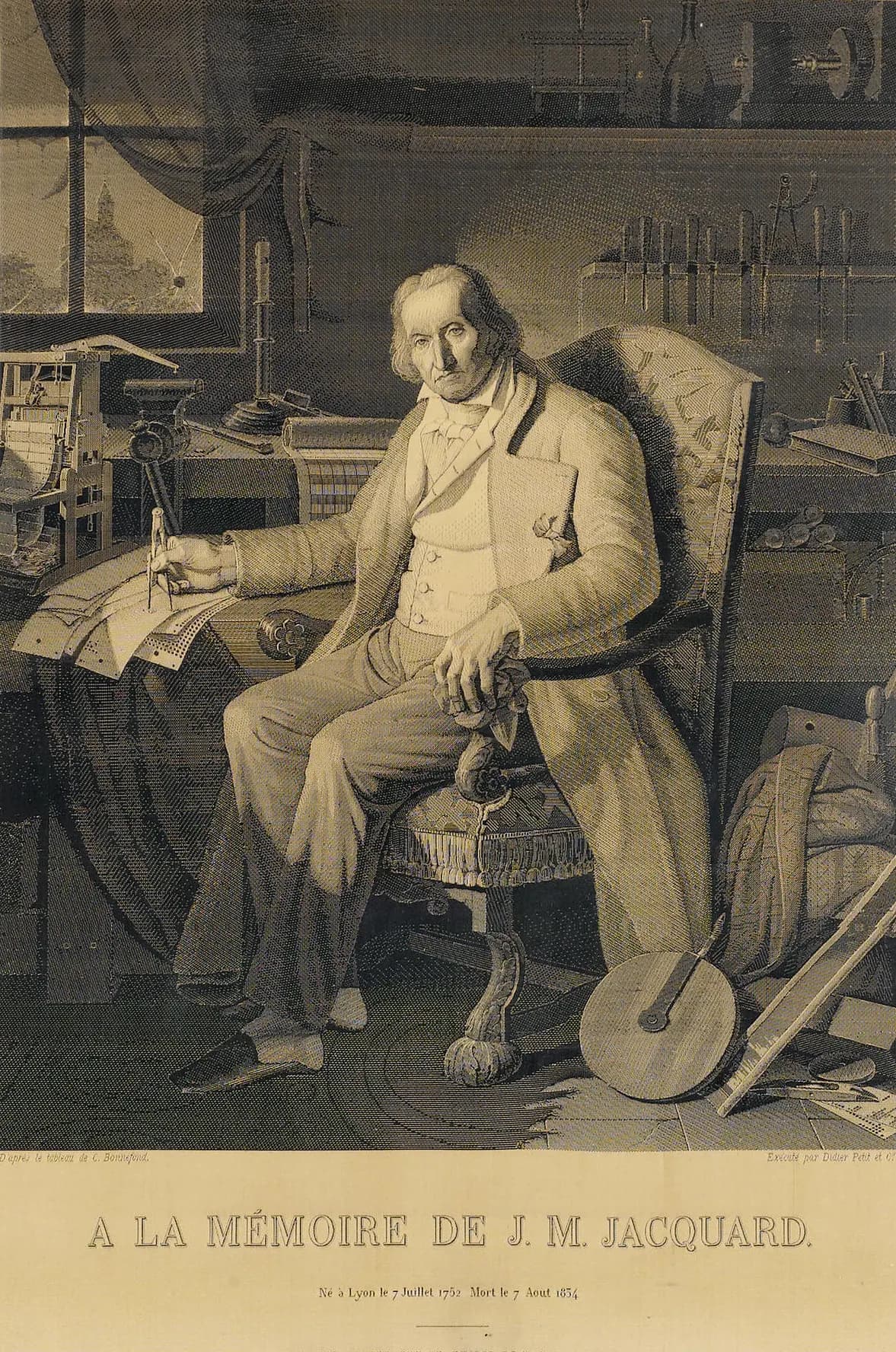
Charles Babbage kept a woven silk portrait of Jacquard. It was so fine that visitors mistook it for an engraving, and it took about 24,000 cards to produce. For Babbage it showed how much information cards could hold. His Analytical Engine would take its instructions the same way.
From silk to census to IBM
Punched cards then moved into data processing. Herman Hollerith used them to tabulate the 1890 US census, which took a fraction of the time the 1880 count had needed. His company later merged into what became IBM. Punched cards remained the main way to program computers until the 1970s.
The weavers of Lyon were not grateful. Jacquard’s looms were attacked by workers who feared for their jobs, an early chapter in the long argument about automation.
Bring it up
“Computer programming arguably started in the silk industry of Lyon.”
Follow the thread
- RelatedA Hollywood star patented a secret radio system Their synchronisation idea came from the player piano: another machine controlled by punched rolls.
- InfluencedThe first computer programmer was a poet’s daughter Lovelace used the loom to explain how the Analytical Engine worked.
- Leads toThe computer that was designed in 1837 Babbage adopted punched cards to program his engine.
- RelatedThe chess-playing machine that had a man inside The age of clever automata that also produced programmable looms.