A noodle dish whose name has 58 strokes
Xi’an’s wide, hand-pulled biangbiang noodles are written with one of the most complex Chinese characters in use. It wasn’t in any dictionary, and only entered Unicode in 2020.
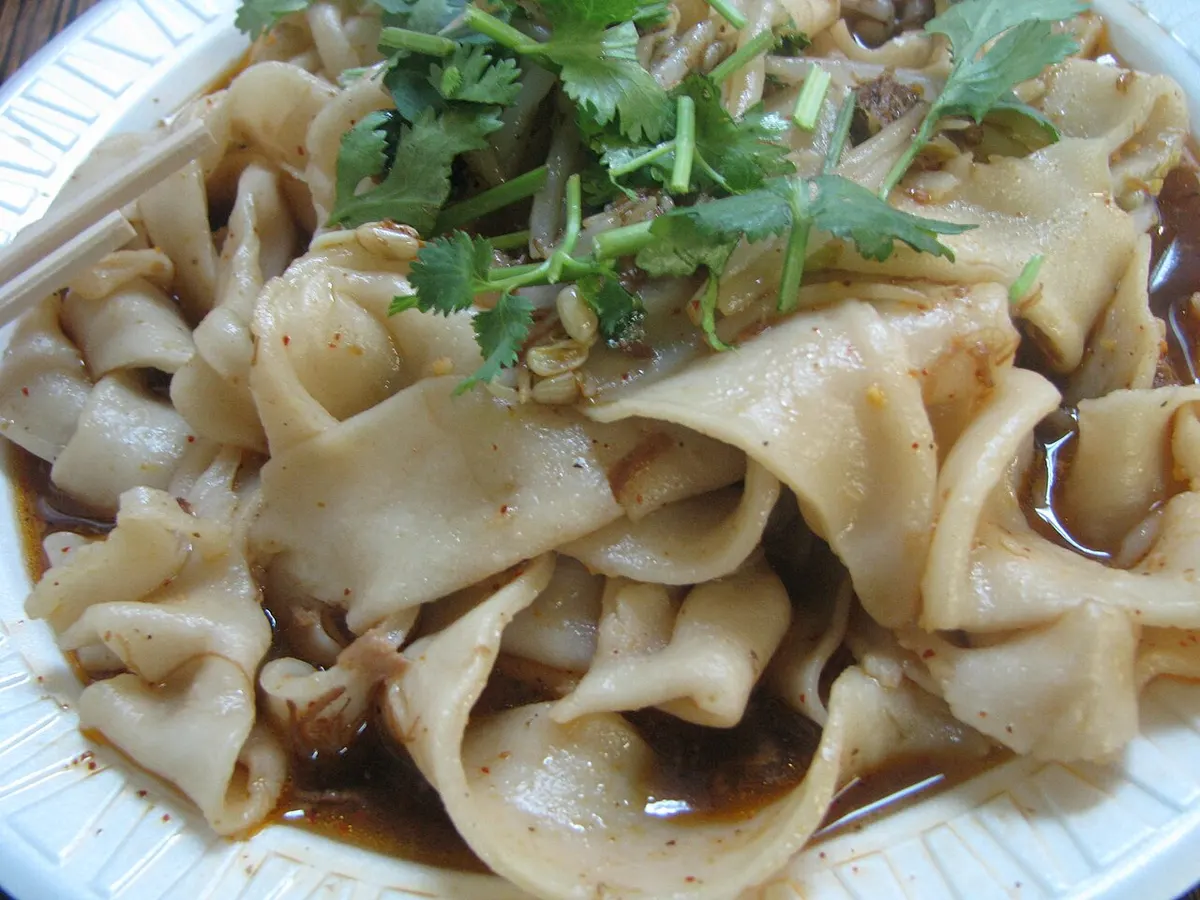
In Xi’an, cooks stretch dough into long, broad belts, sometimes as wide as a belt, and slap them against the counter as they pull. The noodles are boiled and topped with chilli flakes, garlic and spring onion, then doused with sizzling oil. They come from Shaanxi cuisine and were once a filling, quick meal for workers.
The character
The name is written with a single character for biáng, repeated twice. In its traditional form it has 58 strokes, or 42 in simplified Chinese, and variants run from 56 to 71. It is one of the most complex characters in modern use. It contains, among other parts, the characters for speech, horse, long, moon, heart and knife.
It was not in the Kangxi dictionary or in modern dictionaries. For years, menus and signs printed it as a picture, or wrote the name in pinyin. Only on 20 March 2020 did Unicode 13.0 add it (U+30EDE traditional, U+30EDD simplified), so it could finally be typed.
How people remember it
Locals learn it through a rhyme that walks through the strokes:
A dot rises to the sky, / Over two bends by the Yellow River’s side. / An eight opens wide, / Speech enters inside…
The name biáng is most likely onomatopoeia: the slap of the dough hitting the table.
See it move
The character biáng (traditional form) written stroke by stroke.
Bring it up
“There’s a noodle dish in Xi’an whose name is so complicated you couldn’t type it on a computer until 2020.”
Follow the thread
- RelatedWho lives in Xi’an’s Muslim Quarter Xi’an’s food streets are where most visitors first try them.
- Same pattern“Ye Olde Shoppe” was always pronounced “the” When writing technology lacks a character, people improvise.
- RelatedSichuan pepper makes your lips buzz at 50 Hz Another pillar of western Chinese flavour: chilli oil, garlic and spice.
- RelatedKazakh has been written in three alphabets in a century Writing systems and technology meet again: what can and can’t be typed matters.