Why the sky is blue, and not violet
Air scatters blue light more than red. By that logic the sky should be violet. Here is why it isn’t.
Sunlight contains every colour. When it passes through air, light scatters off gas molecules far smaller than its wavelength. Lord Rayleigh showed in the 1870s that this scattering depends very strongly on wavelength: proportional to 1/λ⁴. Blue light (about 450 nm) scatters roughly four to five times more than red (about 700 nm).
So wherever you look away from the Sun, you see scattered short-wavelength light: the blue sky.
Then why not violet?
Violet light scatters even more than blue. Three things work against it:
- Sunlight contains less violet than blue to begin with.
- Some violet and ultraviolet is absorbed high in the atmosphere.
- Our eyes’ colour sensors are much less sensitive to violet, and the mix of light reaching them registers as sky blue.
Sunsets and Mars
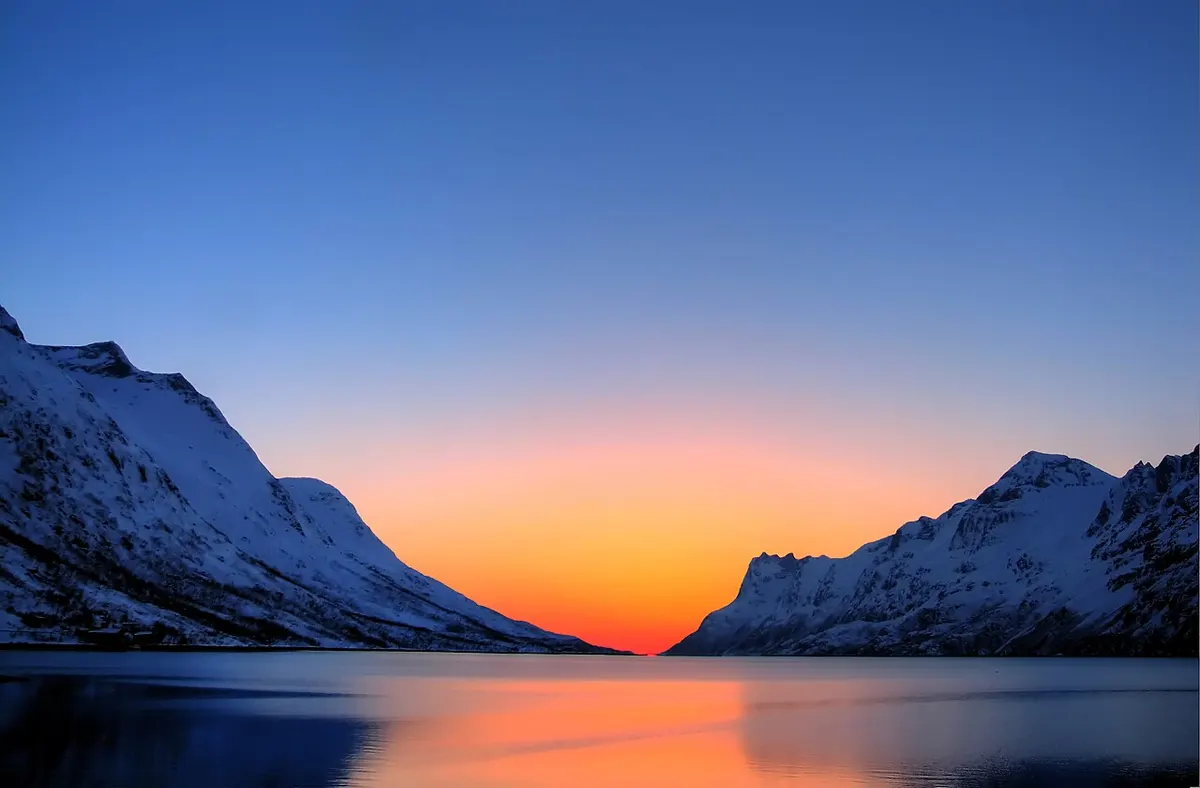
At sunset, light passes through much more atmosphere. Most blue is scattered away before it reaches you, leaving oranges and reds. Dust, smoke and volcanic particles make sunsets more intense.
On Mars, fine dust scatters light differently: the daytime sky looks butterscotch, and sunsets have a blue glow around the Sun. They are the reverse of ours.
Bring it up
“Sunsets on Mars are blue, the opposite of ours.”