Once you notice something, it’s everywhere
You learn a new word, and the next day you see it three times. The world didn’t change; your attention did.
2 min read
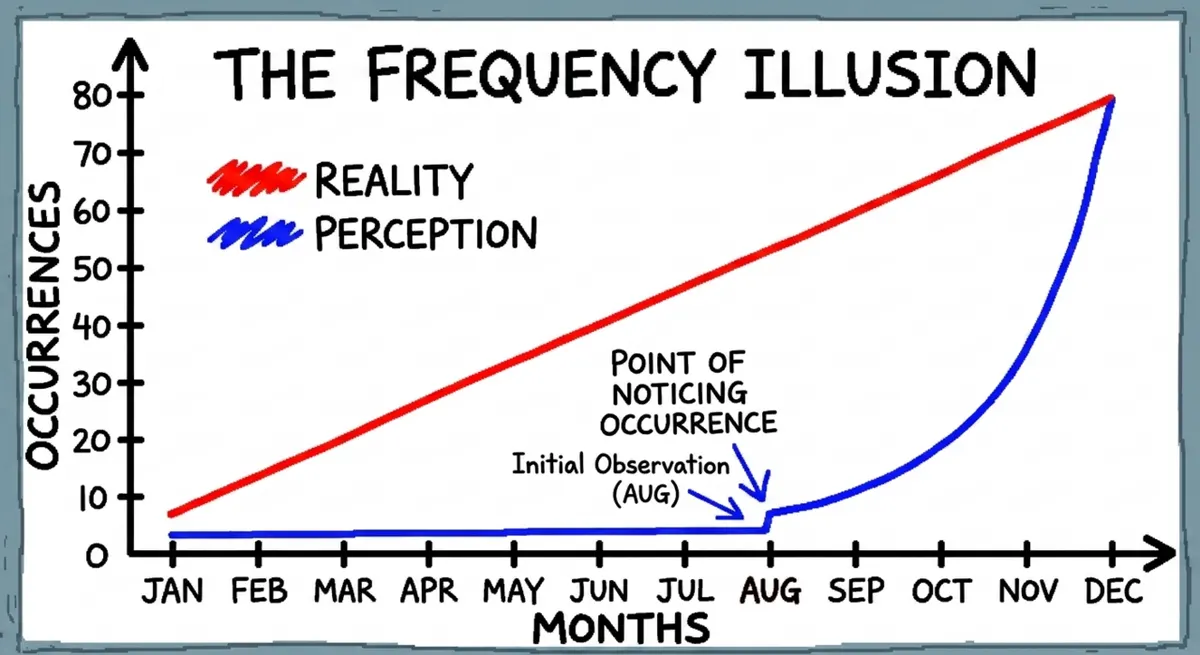
Buy a red car and red cars seem to appear everywhere. Learn the word “sonder” and you will meet it twice this week. This happens to almost everyone, and it has two parts:
- Selective attention. Your brain filters out most of what you see. Once something becomes relevant, it gets through the filter.
- Confirmation bias. Every new sighting feels like evidence that the thing really has become more common. You don’t count the days you didn’t see it.
Where the name comes from
In 1994 a reader of the St. Paul Pioneer Press wrote in to say that after first hearing of the Baader–Meinhof group (a West German militant organisation), he heard it mentioned again within 24 hours. Other readers wrote in with similar experiences, and the name stuck online. In 2005 the Stanford linguist Arnold Zwicky gave it the more descriptive name frequency illusion.
Why it’s useful to know
- Learning: it is a good sign. Your brain has started indexing the new idea.
- Health anxiety: after reading about a symptom, you will notice it more. That is the illusion, not necessarily the illness.
- Marketing: advertisers rely on it. A single exposure makes later encounters stand out.
This platform is, in a way, designed to produce the frequency illusion on purpose.
Bring it up
“There’s a name for when you learn a new word and then see it everywhere, and the name itself comes from a 1994 letter to a newspaper.”
Follow the thread
- Same patternThe Bechdel test began as a joke in a comic strip Once you know the test you start seeing it everywhere, much like noticing a newly learned word.
- RelatedThe Dunning–Kruger effect is not what the internet says Another cognitive bias that the internet loves to cite, and sometimes cites imprecisely.
- RelatedIn a room of 23 people, two probably share a birthday Both are cases where coincidences feel more meaningful than the numbers justify.
- RelatedHow trends spread, from royal courts to TikTok Once a trend is named, you start seeing it everywhere, which helps spread it further.
- RelatedThe same face, three different emotions In both, the mind supplies a pattern that isn’t really in the data.
- Same patternWhy “mama” sounds the same almost everywhere Parents hear meaning in their baby’s babble, just as we notice patterns once we expect them.