The Sator Square
A five-word Latin puzzle scratched on a wall in Pompeii reads the same in four directions. Nobody agrees on what it means.
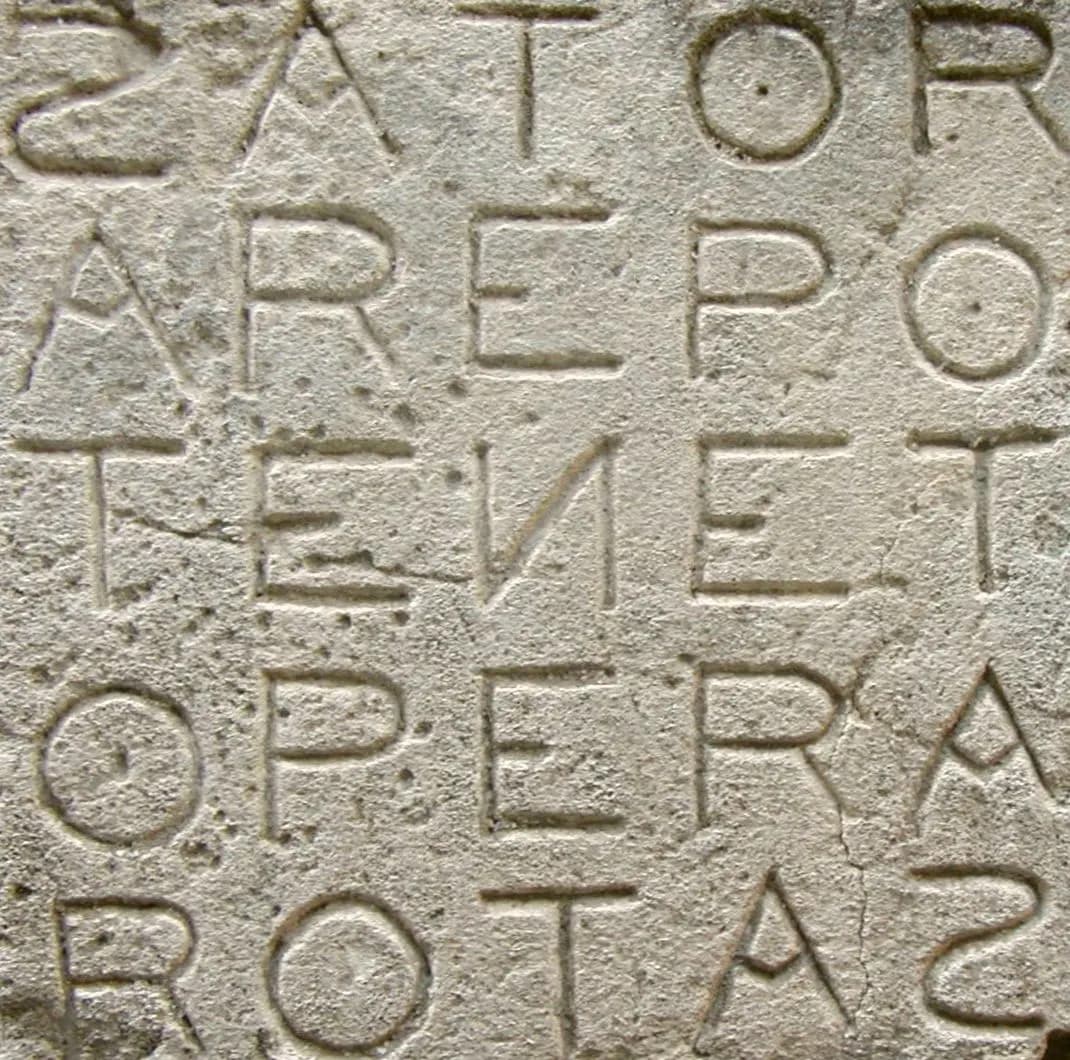
S A T O R
A R E P O
T E N E T
O P E R A
R O T A S
Read it left to right, right to left, top to bottom or bottom to top: you get the same five words every time. The central word TENET forms a cross.
Roughly, the Latin means “The sower Arepo holds the wheels with effort”. AREPO is the problem: it appears nowhere else in Latin and may be an invented name made to fit the puzzle.
Where it turns up
Examples were scratched into walls in Pompeii, and so must date from before the eruption of 79 AD. Others were found at Dura-Europos in Syria, and in later centuries the square appears on church walls, in manuscripts, on amulets, and in folk charms against fire and fever. It was still being written on things in the 1800s.
In cinema
Christopher Nolan’s Tenet (2020) uses all five words: the villain Sator, the forger Arepo, the organisation Tenet, the opera house siege at the start, and Rotas Security. The film is about time running backwards, which makes it a fitting borrowing for a puzzle that reads the same in both directions.
Bring it up
“Every main name in Nolan’s film Tenet (Sator, Arepo, Rotas, the opera) comes from a word square found in the ruins of Pompeii.”
Follow the thread
- RelatedThe devil’s interval was never banned Both are old-looking curiosities tied to stories of the diabolical that are more complicated than they seem.
- RelatedThe novel with no letter E Another text whose form is as deliberate as its meaning.
- Same patternPalindromes are written into your DNA The square is a palindrome in two dimensions at once.
- RelatedJulius Caesar’s secret code (and why it failed) Its supposed hidden PATERNOSTER message has made it a classic case for codebreakers.
- RelatedThe same face, three different emotions Tenet, the film that borrowed the square, is about time running in both directions, which is what the square does with letters.